




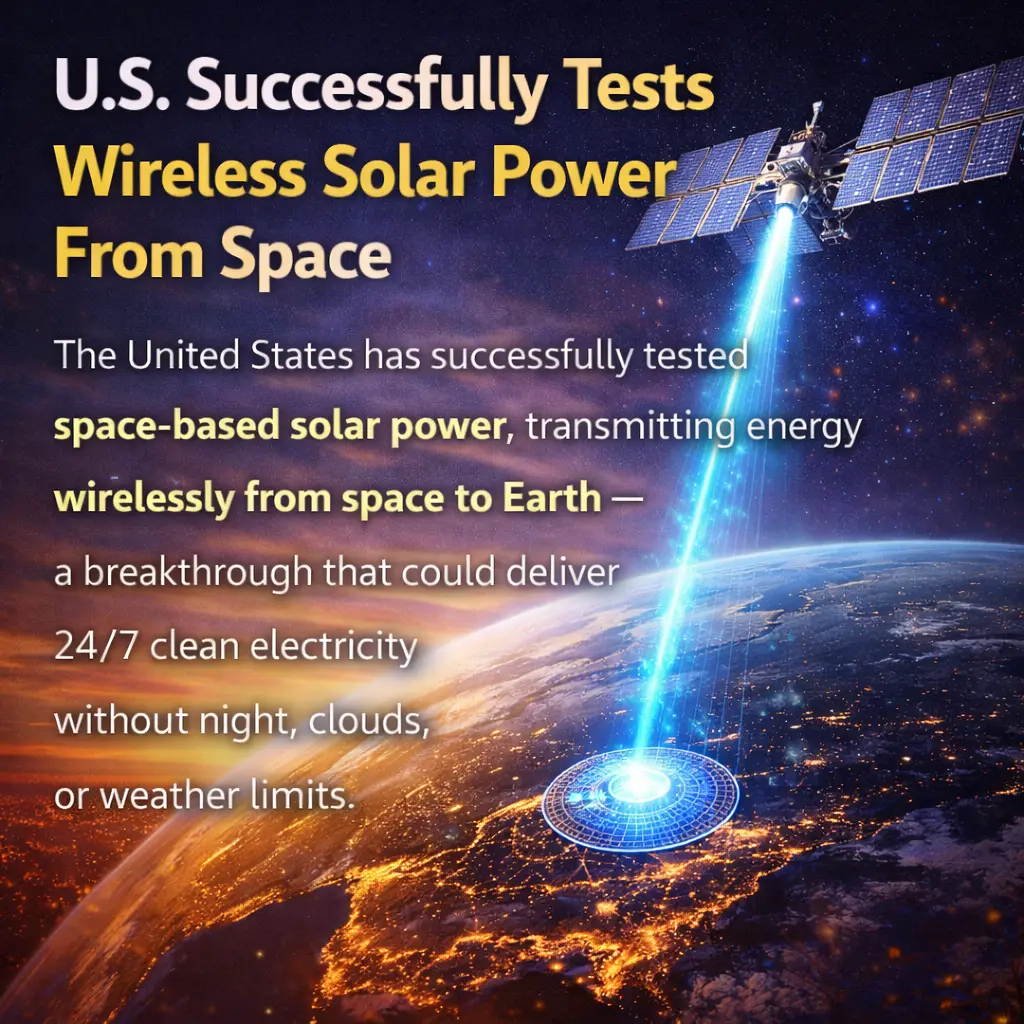
The United States has successfully completed a landmark test of space-based solar power, transmitting energy wirelessly from orbit back to Earth. The breakthrough demonstrates that solar energy collected in space can be converted into electricity on the ground—day and night, regardless of clouds or weather—opening the door to a new class of 24/7 clean power infrastructure.
How Space-Based Solar Power Works
Unlike ground-based solar farms, space-based systems operate above the atmosphere, where sunlight is constant and unobstructed. The process involves:
- Large solar arrays deployed in orbit
- Conversion of sunlight into electrical energy
- Transformation of electricity into microwave or radio-frequency signals
- Wireless transmission of energy to Earth
- Ground receivers converting the signal back into usable electricity
Because the transmission uses non-ionizing radio frequencies, it can be precisely targeted and safely received.
The Breakthrough Test
The recent U.S. test validated the end-to-end system—from space collection to ground reception. Engineers confirmed that:
- Power was successfully generated in orbit
- Energy was transmitted wirelessly over long distances
- Ground receivers captured and converted the signal efficiently
While the transmitted power level was modest, the test proved the physics and engineering behind space-based solar power are viable.
Why This Is a Big Deal
Traditional renewable energy faces limits:
- Solar stops at night
- Weather reduces output
- Storage adds cost and complexity
Space-based solar power bypasses these constraints entirely. Key advantages include:
- Continuous energy generation (24/7)
- Zero emissions during operation
- No land-use conflicts
- Predictable and dispatchable power
This makes it fundamentally different from terrestrial solar or wind.
Who Is Leading the Effort
The test involved collaboration between U.S. research institutions and government-backed programs, including work linked to U.S. Department of Defense research initiatives and academic partners such as California Institute of Technology, which has been developing modular space solar prototypes.
Potential Applications
If scaled, space-based solar power could:
- Supply baseload clean electricity to cities
- Power remote military or disaster zones
- Reduce reliance on fossil fuels and batteries
- Stabilize grids during extreme weather
Energy could be beamed to different locations on demand, offering unmatched flexibility.
Challenges Still Ahead
Despite success, major hurdles remain:
- Launch and deployment costs
- Scaling power transmission from watts to gigawatts
- Long-term durability in space
- Regulatory frameworks for orbital energy infrastructure
However, declining launch costs and advances in lightweight materials are steadily improving feasibility.
Why This Changes the Energy Conversation
For decades, space-based solar power was considered science fiction. This successful test moves it into the realm of practical engineering, suggesting that future clean energy systems may extend beyond Earth’s surface.
The successful U.S. test of wireless solar power from space represents a historic step toward limitless, always-on clean electricity. While commercial deployment remains years away, the demonstration confirms that space-based solar power is no longer theoretical—it is a credible pathway to solving some of the hardest challenges in global energy generation.