




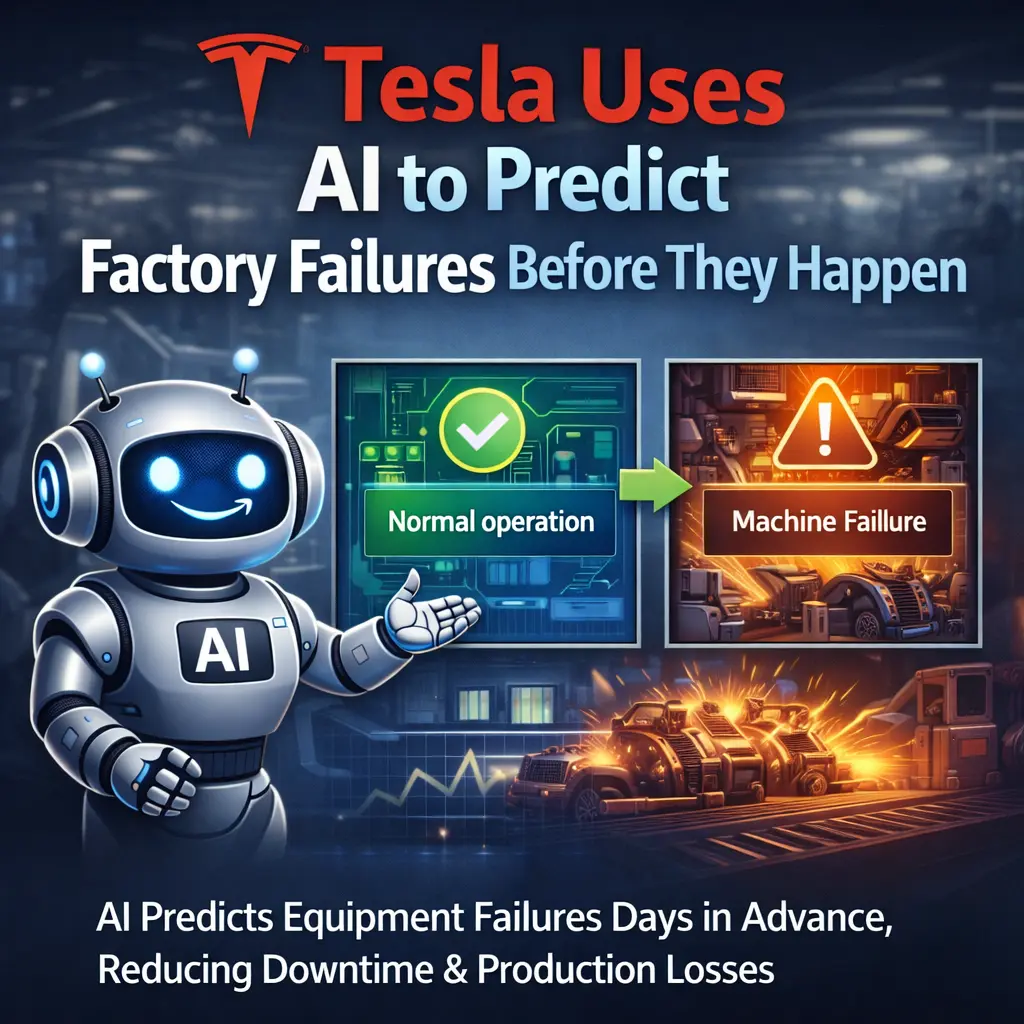
Tesla has implemented advanced AI-driven predictive maintenance systems across its manufacturing facilities, enabling the company to identify potential machine failures days before they occur. The initiative is designed to reduce unplanned downtime, improve production efficiency, and minimize costly disruptions across Tesla’s global factory network.
How Tesla’s Predictive AI Works
The system continuously analyzes data from thousands of sensors embedded in factory equipment. These sensors monitor:
- Temperature and vibration patterns
- Motor load and power consumption
- Cycle times and mechanical wear indicators
Machine learning models then detect anomalies and degradation trends that human operators or traditional monitoring systems might miss. When risk thresholds are crossed, maintenance teams receive early warnings—often days in advance.
Reducing Downtime and Production Losses
Unplanned equipment failures can halt entire production lines. Tesla’s AI approach helps:
- Schedule maintenance before breakdowns occur
- Prevent cascading failures across interconnected machines
- Maintain stable production targets during high-demand periods
Internal estimates suggest predictive maintenance can reduce downtime by 20–30%, translating into meaningful cost savings at scale.
Integration Across Gigafactories
Tesla has deployed these AI systems across multiple Gigafactories, including facilities in North America, Europe, and Asia. The models are trained on historical failure data and continuously updated with live operational inputs, allowing them to adapt to different factory layouts and equipment types.
This centralized learning approach enables improvements at one factory to benefit the entire manufacturing network.
Why AI Maintenance Is a Competitive Advantage
Tesla’s manufacturing strategy emphasizes vertical integration and software-driven optimization. Predictive maintenance reinforces that approach by:
- Increasing equipment lifespan
- Improving worker safety
- Reducing reliance on reactive repairs
- Enhancing overall factory throughput
Few automakers operate with this level of real-time, AI-based factory intelligence.
Part of Tesla’s Broader AI Strategy
This factory deployment aligns with Tesla’s broader use of AI across its business—from vehicle autonomy to supply chain optimization. By embedding intelligence directly into production infrastructure, Tesla is treating manufacturing itself as a software problem.
What Comes Next
Tesla is expected to expand these predictive systems further by:
- Integrating computer vision for visual defect detection
- Linking AI predictions to automated maintenance scheduling
- Using digital twins to simulate factory stress scenarios
These additions could push factory efficiency even higher.
By using AI to predict machine failures before they happen, Tesla is redefining industrial reliability. The approach reduces downtime, cuts costs, and strengthens production resilience—demonstrating how artificial intelligence is becoming a core component of modern manufacturing operations.