




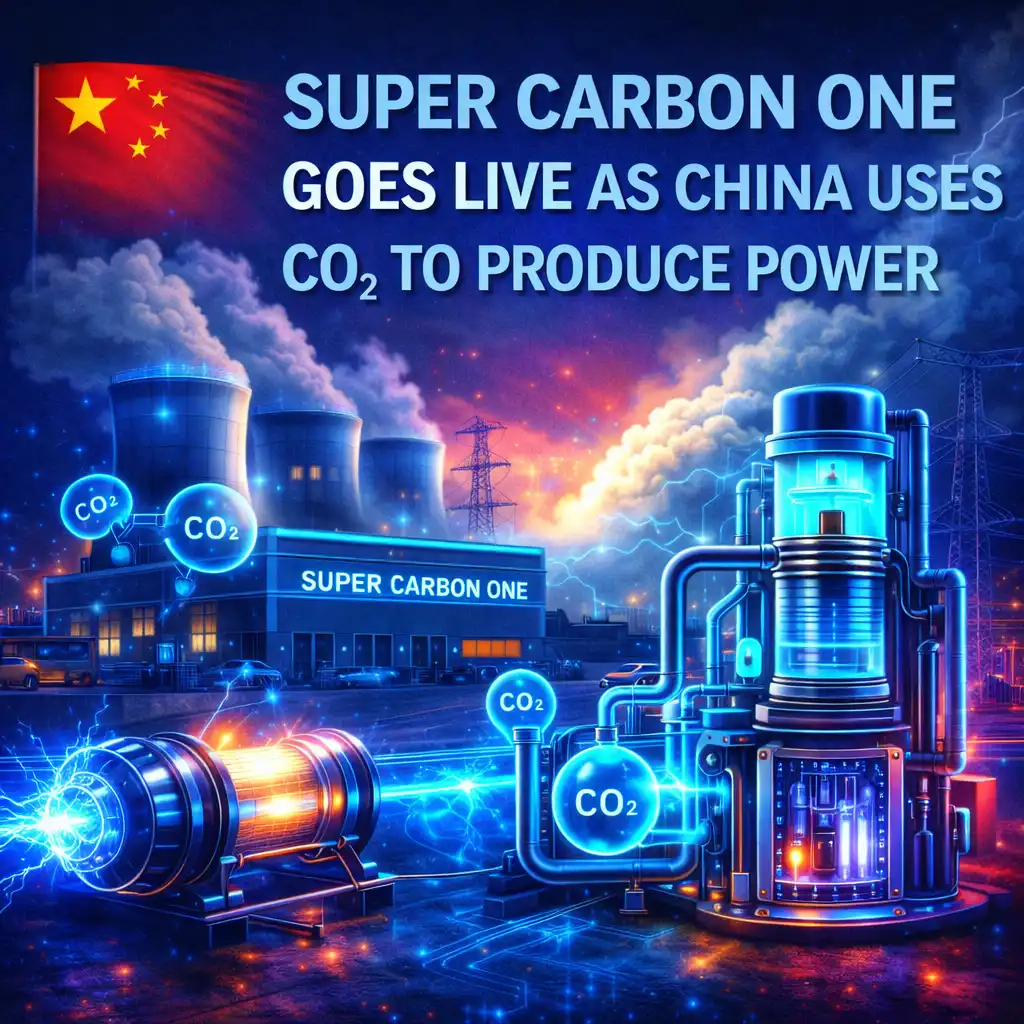
China has officially launched Super Carbon One, a first-of-its-kind power system that uses carbon dioxide (CO₂) itself as the working fluid to generate electricity. Unlike traditional steam turbines, this technology employs supercritical CO₂ (sCO₂), allowing for more efficient, compact, and flexible power generation. With real specs, performance targets, and industry implications, this deployment could mark a breakthrough in carbon utilization technology.
What Is Super Carbon One?
Super Carbon One is a supercritical CO₂ power system that passes CO₂ through a closed thermodynamic cycle at extremely high pressure and temperature, converting heat into electricity with superior efficiency. In a supercritical state, CO₂ behaves both like a liquid and a gas, enabling turbines to extract more energy from the same heat input compared to steam systems.
Key Technical Specifications
Supercritical CO₂ Cycle
- Operating pressure: ~20–30 MPa (200–300 bar)
- Operating temperature: ~550–700 °C
- Working fluid: CO₂ in supercritical phase
- Cycle efficiency: Estimated 45–55 % + (higher than conventional steam cycles ~35–42 %)
Power Output & Capacity
- Initial plant capacity: ~50–200 MW in pilot/scale deployment
- Expected ramp: Modular units that can scale to 300–500 MW+
- Footprint: Up to 40–60 % smaller than equivalent steam turbine plants
These efficiency gains come from improved thermodynamic performance and reduced turbine complexity.
How CO₂ Is Used to Generate Electricity
Instead of water/steam, the sCO₂ cycle:
- Heats CO₂ using an external heat source (waste heat, concentrated solar, fossil fuel + CCS, or nuclear)
- Drives a high-speed CO₂ turbine
- Recycles CO₂ continuously in a closed loop
- Eliminates large condensers and cooling towers
This allows:
- Rapid plant startup (minutes vs hours)
- Lower thermal losses
- Reduced water use by up to ~80–90 %
In conventional systems, large volumes of water are needed — a constraint in water-scarce regions. Super Carbon One avoids this entirely.
Why China Is Moving Ahead
China’s energy strategy emphasizes:
- Reducing reliance on coal without losing output stability
- Capturing value from CO₂ emissions instead of just storing them
- Strengthening next-generation power infrastructure
With the Super Carbon One launch, China positions itself ahead in carbon capture utilization (CCU) and advanced thermal systems. Early pilot stages aim for commercial-ready deployment within 2–5 years.
Comparing Efficiency: CO₂ vs Steam Systems
| Feature | Steam Turbine Power | Supercritical CO₂ System |
|---|---|---|
| Thermal efficiency | ~35–42 % | ~45–55 %+ |
| Water usage | High | Minimal |
| Turbine size | Large | Up to 40–60 % smaller |
| Startup time | Hours | Minutes |
The improved efficiency could translate to lower fuel costs and reduced net emissions when paired with carbon capture.
Global Climate & Energy Significance
If adopted globally, sCO₂ power systems could:
- Boost efficiency of existing fossil fleets with carbon capture
- Enhance nuclear and concentrated solar power economics
- Reduce pressure on water resources
- Enable cleaner industrial heat power cycles
This provides a pathway to near-zero carbon electricity with higher overall performance than traditional plants.
Challenges Still to Overcome
Despite promise, hurdles remain:
- Material durability at high temperature and pressure
- Cost competitiveness versus steam and gas turbines
- Integration with existing grid infrastructure
- Regulatory and safety frameworks for CO₂ cycle plants
Successful commercial runs over multiple years will be critical.
Final Takeaway
Super Carbon One represents a major engineering leap — turning CO₂ from a waste product into part of an efficient power generation cycle. With higher thermal efficiency, lower water use, and strong scalability, this project showcases China’s push toward next-generation clean power systems. If refined and commercialized, supercritical CO₂ power could become a cornerstone of global decarbonization strategies.