



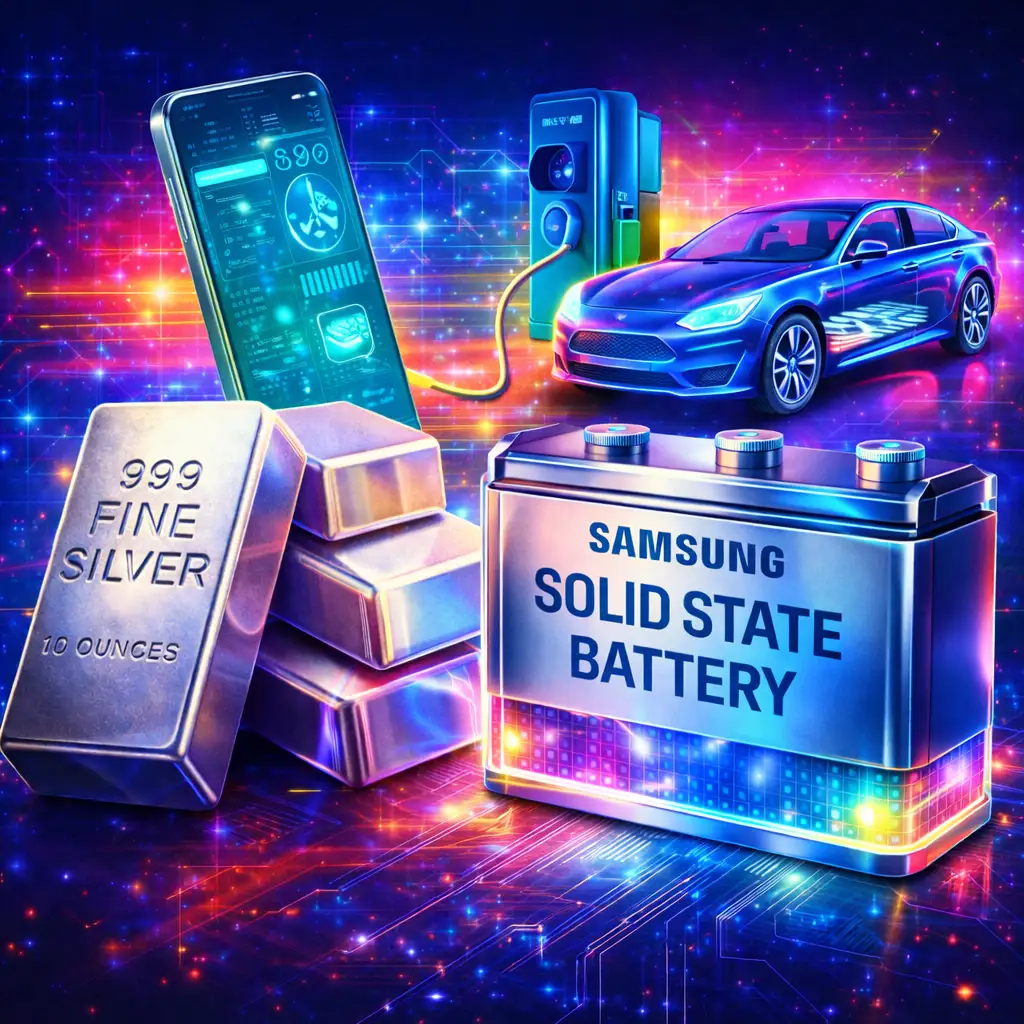
Samsung’s recent advances in next-generation EV battery technology are dominating discussions across social media, industry forums, and investment circles. The company’s prototype solid-state battery claims up to 600 miles (about 965 km) of range, extremely fast charging in around nine minutes, and an exceptionally long lifespan — a combination that could redefine electric vehicles (EVs) if commercialized.
However, many analysts are now pointing to a looming materials bottleneck — especially related to silver — that could limit how fast this technology scales in the real world.
What Samsung’s Battery Technology Actually Delivers
Samsung’s solid-state EV battery prototype, showcased at industry events like SNE Battery Day, targets performance far beyond today’s lithium-ion cells:
- Range: Up to ~600 miles (~965 km) on a single charge
- Charging time: ~9 minutes to 80 % state of charge
- Longevity: Potential lifespan of ~20 years
- Energy density: Approximately 500 Wh/kg — nearly double conventional EV batteries
These gains come from replacing liquid electrolytes with solid electrolytes, which allow higher energy density and improved safety. This opens the door to slimmer, lighter battery packs and faster charging without overheating — a persistent problem in current EVs.
But Samsung’s technology is still in pilot production and testing stages with auto manufacturers. Mass-market rollout is expected later this decade, contingent on scalability and cost improvements.
Why This Could Truly Transform the EV Market
If Samsung’s technology becomes commercially available:
- Range anxiety, one of the biggest barriers to EV adoption, would be dramatically reduced.
- Fast charging times rivaling gas-pump refills would make long trips far more convenient.
- Long battery lifespans could slash total cost of ownership.
- Vehicles could be designed with lighter and more efficient energy systems.
This is why the term “petrol killer” is now widely mentioned in headlines and social posts.
The Silver Supply Challenge
However, there’s another part of the story gaining traction online: the materials needed to produce these advanced batteries at scale.
Solid-state and next-gen battery chemistries often require greater quantities of high-conductivity materials such as silver, which plays important roles in advanced electrical connections, current collectors, and conductive paste.
According to industry estimates circulating in blockchain and commodities forums, the amount of silver required to support a rapid global shift to these EV batteries could consume a huge percentage — up to ~60–65 % — of annual global silver mining output. This is especially striking because much of the silver mined today is already committed to existing industries like solar, electronics, and medical equipment, meaning there’s minimal slack in current supply.
In short, if EV adoption — especially with 600-mile battery tech — ramps up fast, silver demand could spike dramatically, potentially pushing prices higher and raising sourcing challenges.
Balancing Innovation With Real-World Limits
Samsung’s solid-state battery breakthrough is real — and it’s one of the most exciting developments in EV tech in years. But there are two major realities to keep in mind:
- Commercial production timelines are still years out, with initial testing and pilot production ongoing.
- Materials supply chains, especially for silver, are not guaranteed to scale at the same pace as battery innovation.
This dual narrative — technological optimism alongside supply chain constraint — is why the topic is trending so widely.
Final Takeaway
Samsung’s battery breakthrough points to a future where EVs can rival petrol cars on range and charging convenience. Yet the conversation about silver demand and material shortages underscores that innovation is just one side of the equation — the other is whether global industry can support it.
The EV revolution is accelerating, but it’s still grounded in the realities of raw materials.