




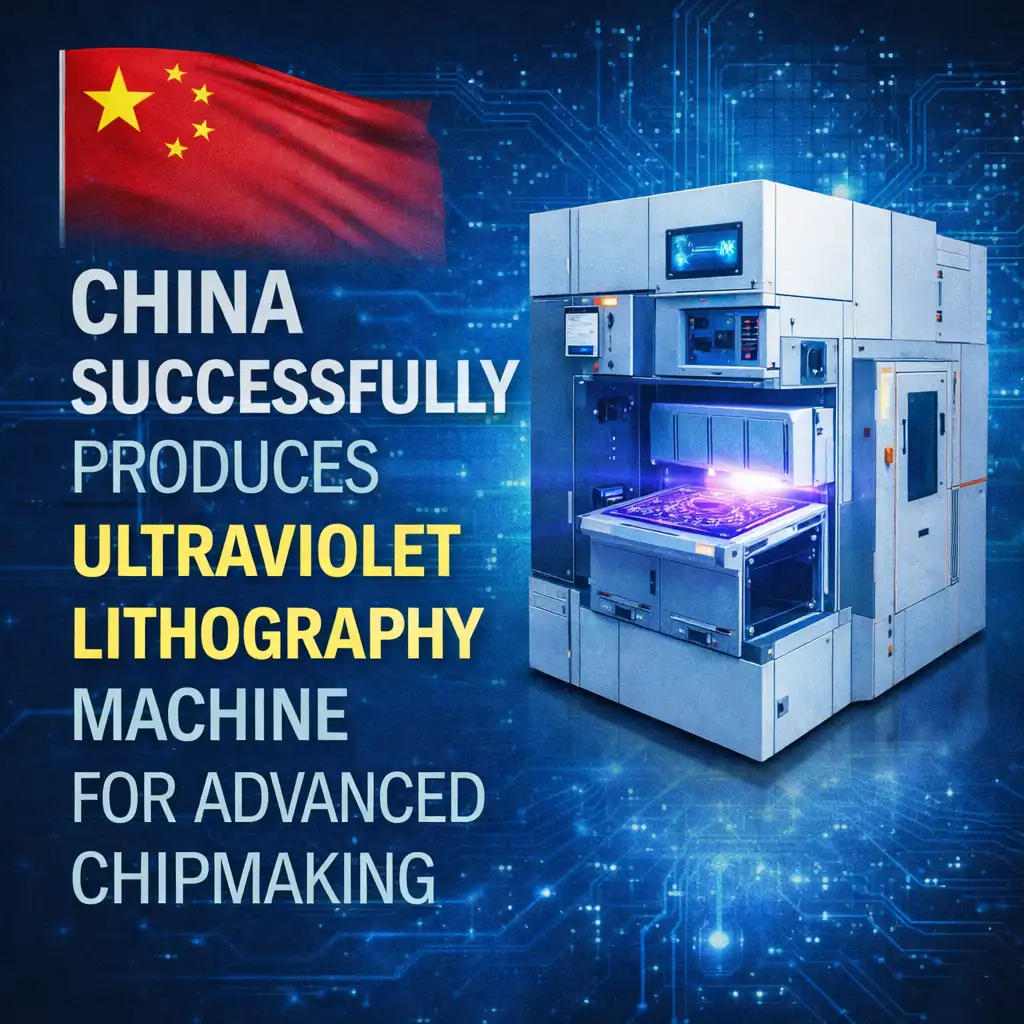
China has achieved a major milestone in semiconductor manufacturing by successfully producing its own ultraviolet (UV) lithography machine, a critical tool for advanced chip fabrication. This development represents a significant step toward technological self-reliance and reduces dependence on foreign semiconductor equipment.
Why Lithography Machines Matter in Chip Manufacturing
Lithography machines are the backbone of modern semiconductor production.
They are used to:
- Etch microscopic circuit patterns onto silicon wafers
- Enable smaller, more powerful, and more energy-efficient chips
- Define the manufacturing limits of advanced processors
Without advanced lithography tools, cutting-edge chip production is impossible.
China’s Ultraviolet System Breaks a Critical Bottleneck
Until now, China relied heavily on imported lithography equipment.
The successful domestic production means:
- Reduced exposure to export restrictions
- Greater control over semiconductor supply chains
- Faster iteration of chip manufacturing technology
This achievement directly addresses one of the biggest constraints facing China’s chip industry.
How This Impacts Advanced Semiconductor Development
With access to domestic UV lithography, Chinese chipmakers can:
- Improve process maturity for advanced nodes
- Increase production capacity
- Accelerate R&D on next-generation chips
- Support AI, data center, and high-performance computing demand
While EUV remains the most advanced tier, high-quality UV systems still enable competitive chip production.
Strategic Importance Amid Global Tech Tensions
Semiconductors are now central to global economic and geopolitical competition.
This breakthrough helps China:
- Strengthen technological sovereignty
- Reduce reliance on Western suppliers
- Maintain momentum in AI and advanced computing
- Secure long-term industrial resilience
It also reshapes the global balance in semiconductor equipment manufacturing.
Challenges Still Ahead
Despite the success, hurdles remain before full parity with global leaders.
Key challenges include:
- Scaling production reliability
- Achieving higher resolution and yield
- Integrating systems into high-volume fabs
- Continuous improvement toward next-gen lithography
However, industry experts see this as a strong foundation for rapid progress.
Global Semiconductor Industry Takes Notice
China’s achievement signals a broader shift.
- Competition in chipmaking tools is intensifying
- Supply chains may become more regionalized
- Innovation pressure on global equipment makers will increase
The semiconductor landscape is entering a more fragmented yet competitive era.
Conclusion: A Major Step Toward Semiconductor Independence
By successfully producing its own ultraviolet lithography machine, China has crossed a critical threshold in advanced chipmaking. While challenges remain, this breakthrough significantly strengthens China’s semiconductor ecosystem and marks a decisive move toward long-term technological independence.