



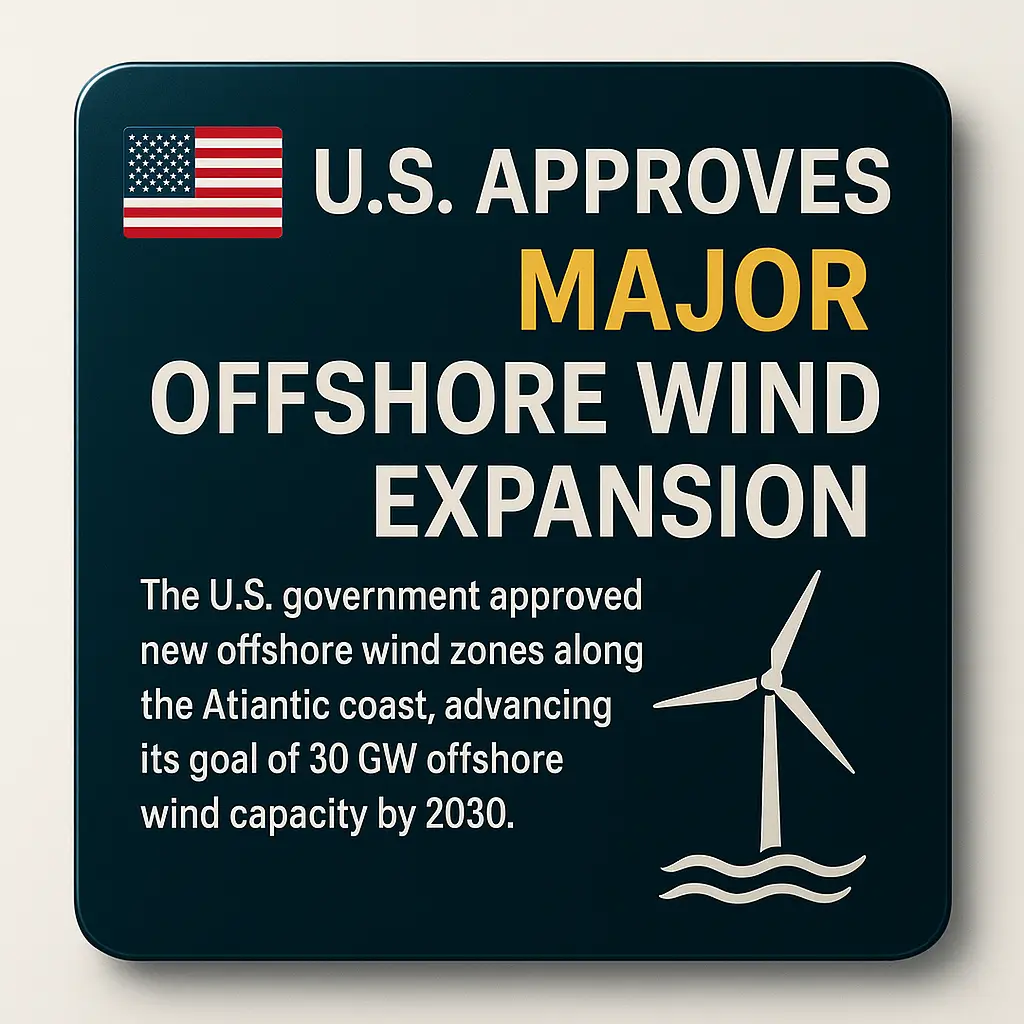
The United States has approved new offshore wind development zones along the Atlantic coast, marking a significant acceleration in the nation’s renewable energy strategy. The decision moves the country closer to its target of 30 gigawatts (GW) of offshore wind capacity by 2030, positioning offshore wind as a cornerstone of the U.S. clean energy transition.
New Wind Zones Open the Door to Large-Scale Deployment
The newly approved areas will enable:
- Construction of utility-scale offshore wind farms
- Long-term leasing for developers
- Expanded grid interconnection planning
These zones significantly increase the pipeline of future offshore projects.
Why Offshore Wind Matters for the East Coast
Atlantic coastal states face rising electricity demand and limited land for large renewables. Offshore wind offers:
- Consistent, high-capacity wind resources
- Proximity to major population centers
- Reduced transmission losses
- Lower reliance on fossil generation
This makes offshore wind uniquely suited for the region.
Progress Toward the 30 GW by 2030 Goal
The approval strengthens federal momentum toward the national offshore target.
- Multiple projects already under construction or contracted
- New zones support second- and third-generation developments
- Federal permitting timelines continue to tighten
Together, these steps bring long-term capacity goals within reach.
Economic and Industrial Impact
Offshore wind expansion supports domestic industry growth.
- Shipbuilding and port upgrades
- Manufacturing of turbines and foundations
- Tens of thousands of skilled jobs
- Supply-chain localization across coastal states
The sector is emerging as a major U.S. industrial growth engine.
Environmental and Grid Benefits
Beyond clean energy, offshore wind delivers broader advantages.
- Significant emissions reductions
- Diversification of power supply
- Improved grid reliability during peak demand
- Reduced exposure to fuel price volatility
Careful marine planning is also being used to minimize ecological impact.
Challenges Still Ahead
Despite approval, hurdles remain.
- High upfront capital costs
- Grid integration complexity
- Transmission upgrades
- Project financing under changing market conditions
Federal and state coordination will be critical to maintain momentum.